
Quick Summary
Securing driveway gate permits requires navigating complex municipal building codes, dedicated electrical requirements, roadway setback rules, and mandatory emergency access regulations. All Star Gate Repair Santa Clarita explains that automated systems typically trigger separate structural and electrical reviews to ensure UL 325 safety compliance, proper vehicle stacking, and full fire department accessibility. Readers will understand how to avoid costly code violations and can schedule a free consultation with local specialists to plan a fully compliant, properly permitted gate installation.
Driveway Gate Permits: How to Get Local Approval
Getting a driveway gate permit approved comes down to understanding how your local building department operates. Permit requirements and plan review processes vary across cities and counties. Local building officials may evaluate automatic gate systems across several areas, as driveway gates can trigger separate building, zoning, fire, and electrical review.
Many property owners assume putting in an entry gate is identical to putting up a backyard fence. In practice, automated driveway gates are electromechanical entry systems. Overlooking local rules can trigger stop-work notices, failed inspections, or costly layout adjustments. At All Star Gate Repair Santa Clarita, our technicians bring over fifteen years of field experience and in-house metal fabrication to help design, build, and permit gate installations that meet regional standards.
Quick Summary
Quick Answer: Some jurisdictions require a building permit for a driveway gate, pillars, or flanking walls, while motorized and automatic systems may also require a separate electrical permit. In some areas, you must also satisfy driveway setback rules and emergency access requirements before the installation will be approved.[2]
In Los Angeles County, building permits are mandatory for fences, gates, and entry structures exceeding six feet in height. Dedicated electrical permits are also required to run branch circuits to the automated gate motor. Other regions establish their own specific structural and electrical rules.[1]
Do You Need a Building and Electrical Permit for an Automatic Driveway Gate?
Whether you need one or both permits depends on the gate design, height, and whether the system runs on an electric operator. Some automated installations involve distinct permits.
Structural Building Permit Requirements
A structural building permit covers physical integrity. City plan checkers review the structural design of posts and overall gate height. Wind load is a major factor in areas like Canyon Country and Stevenson Ranch, where seasonal wind gusts place heavy lateral pressure on large, solid-panel slide or swing gates.
Height thresholds determine permit triggers. In Los Angeles County, structures over six feet tall require engineering approval. Other California cities have their own specific zoning standards. For example, the City of Cupertino permits driveway gates on designated properties under clear design rules, but requires formal public exception hearings for standard parcels seeking gate additions. Local rules also govern sliding gates on steep driveway grades to prevent hardware derailment.[3]
Dedicated Electrical Circuit and Safety Compliance
An electrical permit may be required when trenching power lines to a driveway gate operator. According to All Star Gate Repair Santa Clarita, inspectors verify wire gauge, conduit burial, grounding, and the presence of a dedicated disconnect switch near the motor.
Beyond standard wiring, automated gates often must comply with UL 325 safety standards. This means the operator must include monitored external entrapment protection devices, such as through-beam photo eyes and responsive safety contact edges. If an obstacle, vehicle, or person breaks the infrared beam or hits a reversing edge, the gate must automatically stop and reverse.
What Are the Setback and Fire Department Access Rules for Gates?
Need driveway gate permits?
We’re available now — call for a fast, free estimate.
Setbacks and emergency access requirements prevent neighborhood traffic bottlenecks and ensure first responders can reach your home without delay.
Vehicle Stacking and Roadway Setback Allowances
Stacking depth is the distance between the edge of the public roadway and your closed gate. Planning departments enforce minimum setbacks so a vehicle waiting for the gate to open does not hang into traffic lanes or block public sidewalks.
Setback rules differ across neighborhoods. Some residential zones allow a 20-foot setback, while properties on narrower hillside roads or major collector streets may require a 30-foot or greater vehicle turnaround pocket. Verifying stacking depth on your property survey prevents costly layout revisions during the planning review.
Emergency Services Access Requirements
Some jurisdictions require fire-access review or approved emergency access devices so local fire and emergency medical teams can gain immediate entry. Depending on local requirements, these systems may include:
- Knox Box or Key Switch: A standardized, weather-sealed key cylinder or lockbox keyed directly to the local fire department’s master key.
- Emergency Strobe or Siren Sensors: Optical sensors (like 3M Opticom systems) or sound-activated sensors that automatically open the gate upon detecting emergency vehicle strobe lights or sirens.
- Fail-Safe Battery Backup: A dedicated battery system that automatically swings or slides the gate open and holds it open in the event of a neighborhood power outage or emergency evacuation.
What Factors Influence Driveway Gate Permitting and Installation Costs?
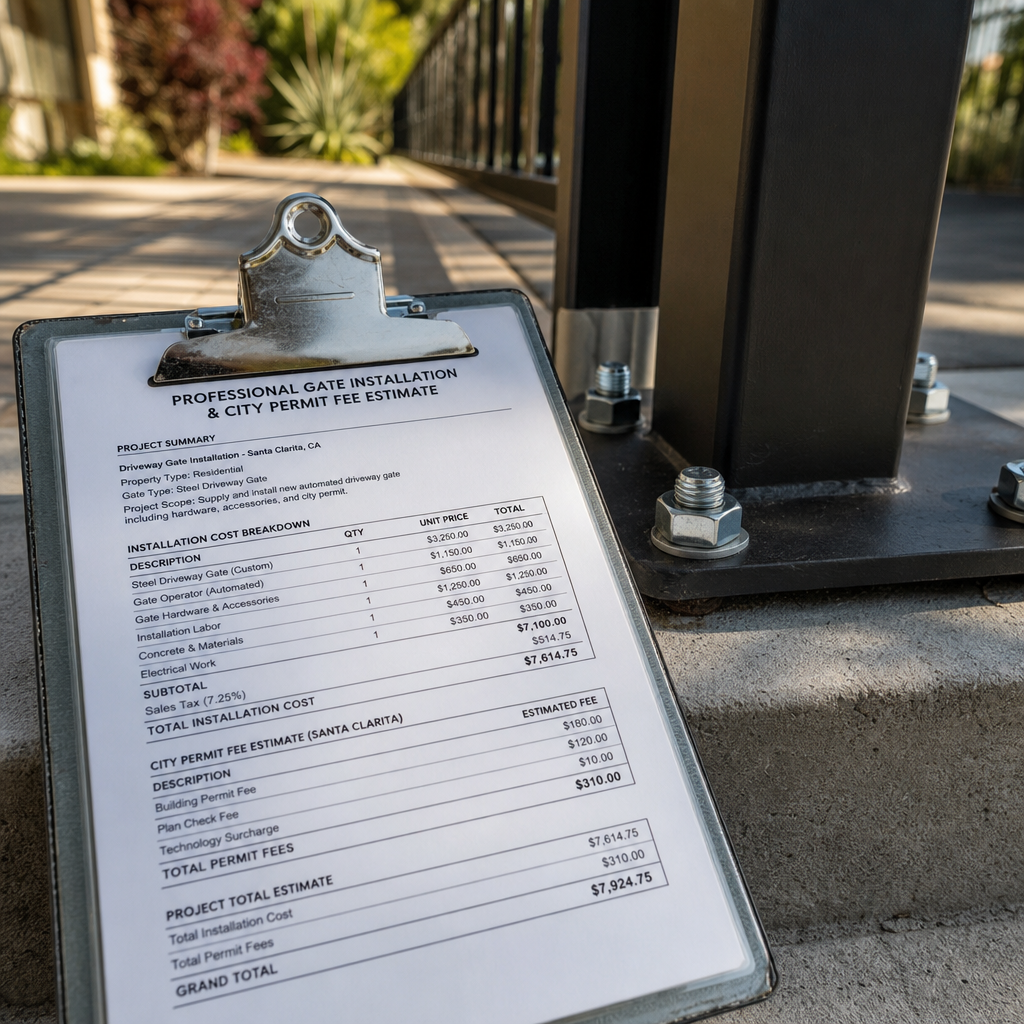
Permit fees and installation costs depend on the scope of your gate project, automation options, and local municipal fee schedules.
Local Permit and Plan Check Fees
Building departments calculate permit costs based on project valuation, the number of required inspections, and administrative plan reviews. Projects requiring zoning variance hearings or exception hearings will incur additional municipal fees.
Hardware, Trenching, and Fabrication Variables
Physical project costs depend on several practical variables:
- Trenching Distance: Long electrical runs from the main home subpanel to the driveway entrance increase labor and conduit material costs.
- Gate Material and Weight: Heavy wrought iron swing gates require substantial support structures and higher-capacity motors compared to lightweight aluminum sliding gates.
- Access Controls: Telephone entry systems, wireless keypads, license plate readers, and vehicle loop detectors add hardware and programming steps to the job.
What Are the Potential Issues with Installing Without Required Permits?
Skipping the permit process exposes property owners to financial, legal, and safety risks.
Code Enforcement and Unpermitted Structure Penalties
If code enforcement discovers an unpermitted gate, they may issue a notice of violation. Property owners may be required to submit retroactive plans, complete delayed inspections, or modify non-compliant installations. In severe cases, non-compliant gates installed inside public right-of-ways or fire clear zones must be removed.
Liability and Real Estate Transaction Complications
Gates without proper safety sensors or fire access equipment create direct liability concerns if an incident occurs. When selling your home, unpermitted structures can show up during title and property disclosures, which may complicate the transaction.
Frequently Asked Questions About Driveway Gate Permits
Do I need a building permit to install a driveway gate on my property?
In some cities and counties, a permit is needed depending on the gate design, height, or electrical connections. In Los Angeles County, for example, permits are mandatory for gates and entry structures exceeding six feet in height. Automated driveway gates can trigger separate building, zoning, fire, and electrical reviews.
How long does the gate permit approval process take?
Permit approval timelines vary depending on your local building department, the scope of the project, and whether additional zoning, historical, or fire department reviews are required.
Do HOA approvals replace municipal permit requirements?
No. An approval from your Homeowners Association (HOA) only confirms that the gate meets neighborhood architectural and aesthetic guidelines. HOA approval does not replace or satisfy municipal building codes, setback laws, or electrical permits required by the city or county.
Will a professional gate contractor handle the permit process?
Some contractors, including All Star Gate Repair Santa Clarita, may help with the permit process, assisting with site plans, structural documentation, and coordinating required inspections.
Need driveway gate permits?
We’re available now — call for a fast, free estimate.
Sources
- Los Angeles County Building and Safety – dpw.lacounty.gov (2002)
- PierceCountyWa.gov/PPW – piercecountywa.gov
- Fences Cupertino CA – cupertino.gov
Frequently Asked Questions
What specific documents are required when submitting a driveway gate permit application?
Most building departments require a scaled plot plan showing property lines, roadway setback distances, and vehicle stacking depth, alongside structural drawings for posts and framing. Automated gates also require electrical line diagrams and UL 325 safety device specifications. All Star Gate Repair Santa Clarita assists property owners in preparing and submitting these technical documents to speed up plan check approval.
Can you get a retroactive permit for an existing unpermitted driveway gate?
Yes, property owners can legalize an existing gate by submitting as-built site plans and passing retroactive structural and electrical inspections. If the current setup violates roadway setbacks or lacks mandatory fire access controls, physical modifications will be required before the city signs off. All Star Gate Repair Santa Clarita can evaluate unpermitted gates to bring framing, wiring, and safety sensors up to local code.
What is the most common reason an automatic driveway gate fails final municipal inspection?
Inspections most commonly fail due to missing UL 325 entrapment devices, such as through-beam photo eyes, or non-compliant emergency access systems like Knox key switches and strobe sensors. Inadequate wiring trench depth and insufficient vehicle stacking clearance from the roadway are also frequent triggers for failed inspections.
About the author
 |
Marcus Dalton Marcus Dalton is a licensed gate repair technician with over a decade of experience serving the Santa Clarita Valley. He holds an associate degree in Electrical Engineering Technology from College of the Canyons and specializes in emergency motor replacements and automated access control systems. Marcus is dedicated to providing homeowners and property managers with practical advice on maintaining secure, reliable entry systems. |
Gate not opening, off track, or opener dead?
We’re available now — call for a fast, free estimate.
Call Now - Free Estimate