
Quick Summary
Industrial security gates require precise structural engineering and continuous-duty operators to handle high-traffic logistics environments while complying with strict UL 325 and ASTM safety standards. Pairing debris-resistant cantilever or tracked designs with properly rated continuous-duty motors and advanced access controls prevents thermal motor failures and costly perimeter security breaches. Facility managers will understand critical gate hardware specifications, maintenance requirements, and turnkey installation costs to confidently contact All Star Gate Repair Santa Clarita for a free commercial consultation or 24/7 repair estimate.
Industrial Security Gates – Fast Setup & 24/7 Protection
Perimeter gates at logistics yards, distribution terminals, and industrial facilities take a severe beating. High daily cycle counts, heavy transport vibration, and extreme temperature swings quickly expose shortcuts in hardware selection or installation. When a main entry gate fails, it stalls supply chains, exposes valuable inventory, and leaves facility managers scrambling for emergency repairs.
Selecting, installing, and maintaining industrial security gates requires balancing structural mass against electromechanical capacity. Matching gate designs to site conditions, understanding safety standards like UL 325 and ASTM, and sizing operators correctly helps keep operations running smoothly around the clock.[1]
Durability Profiles: Cantilever, Tracked, and Overhead Gates
Every industrial property has specific site limitations, from available clearance and grading to dirt exposure and truck traffic. As technicians at All Star Gate Repair Santa Clarita frequently point out, choosing the correct gate design upfront prevents recurring mechanical breakdowns.
Cantilever Security Gates vs. Tracked Slide Gates
The main difference between cantilever and rolling security gates lies in how the gate panel is supported. Cantilever security gates are counterbalanced and do not ride on a ground track.
Rolling gates use a ground rail or track and require a cleaner, flatter, better-maintained surface. For sites handling freight, heavy machinery, or gravel, cantilever sliding security gates offer superior durability and lower lifetime maintenance.
| Gate Type | Debris Sensitivity | Required Footprint | Axle Load Wear | Best Industrial Use Case |
|---|---|---|---|---|
| Cantilever Slide | None (Suspended) | Opening width + 40-50% counterbalance space | None | Logistics yards, freight hubs, unpaved or uneven ground |
| Tracked V-Groove | High (Debris in track) | Opening width + slight run-off | High (Heavy trucks crush track) | Clean paved lots, limited back-run fence lines |
| Industrial Swing | Low | Deep swing radius inside or outside | None (Hinge mounted) | Low-cycle entry points, utility substations |
| Vertical Lift | None | Narrow lateral footprint; requires overhead space | None | Tight urban lots, rail spurs, narrow access alleys |
Structural Standards: ASTM and International Baselines
Heavy duty security gates must comply with strict manufacturing and installation guidelines to ensure structural stability under high wind and daily mechanical strain. ASTM International publishes standards F2200, F900, and F1184 for these gate types:
- ASTM F2200: Standard Specification for Automated Vehicular Gate Construction.
- ASTM F900 & F1184: Specifications covering industrial and commercial steel swing gates and horizontal slide gates.
- SS-EN 13241: European and international standards established by organizations like the Swedish Stöldskyddsföreningen that define mechanical resistance, burglar-resistant properties, and secure locking capabilities for industrial barriers.
The Thermal Duty-Cycle Trap: Why Heavy Gates Stall in Extreme Heat
Need industrial security gates?
We’re available now — call for a fast, free estimate.
A common mistake in commercial security gate installation is over-engineering the physical gate leaf while under-specifying the drive motor. Facility managers often request heavy gauge steel pickets or solid steel cladding for maximum perimeter defense. However, pairing a 2,000-pound gate with a standard electromechanical operator creates a serious reliability flaw.
In regions subject to intense summer heat or rapid temperature shifts, ambient temperatures over 100 degrees Fahrenheit heat up the operator housing. Electric gate motors generate substantial internal heat with every cycle. When a heavy structural gate operates under continuous vehicle traffic, the combination of high ambient heat, friction, and motor load drives internal winding temperatures past the thermal overload switch threshold.
The result is a gate that stops dead in mid-travel during peak shift changes. To prevent this failure mode, high security perimeter gates require:
- Continuous-duty brushless or hydraulic operators: Units rated for 100% duty cycles that dissipate heat through oil baths or dedicated cooling fans rather than relying on intermittent-duty motors.
- Proper counter-weighting and low-friction trucks: Precision-machined, internal roller assemblies reduce mechanical drag so the motor works less per cycle.
- Variable frequency drives (VFD): Ramped acceleration and soft-stop deceleration curves minimize torque spikes on the gearbox during starts and stops.
Core Mechanical and Electrical Components
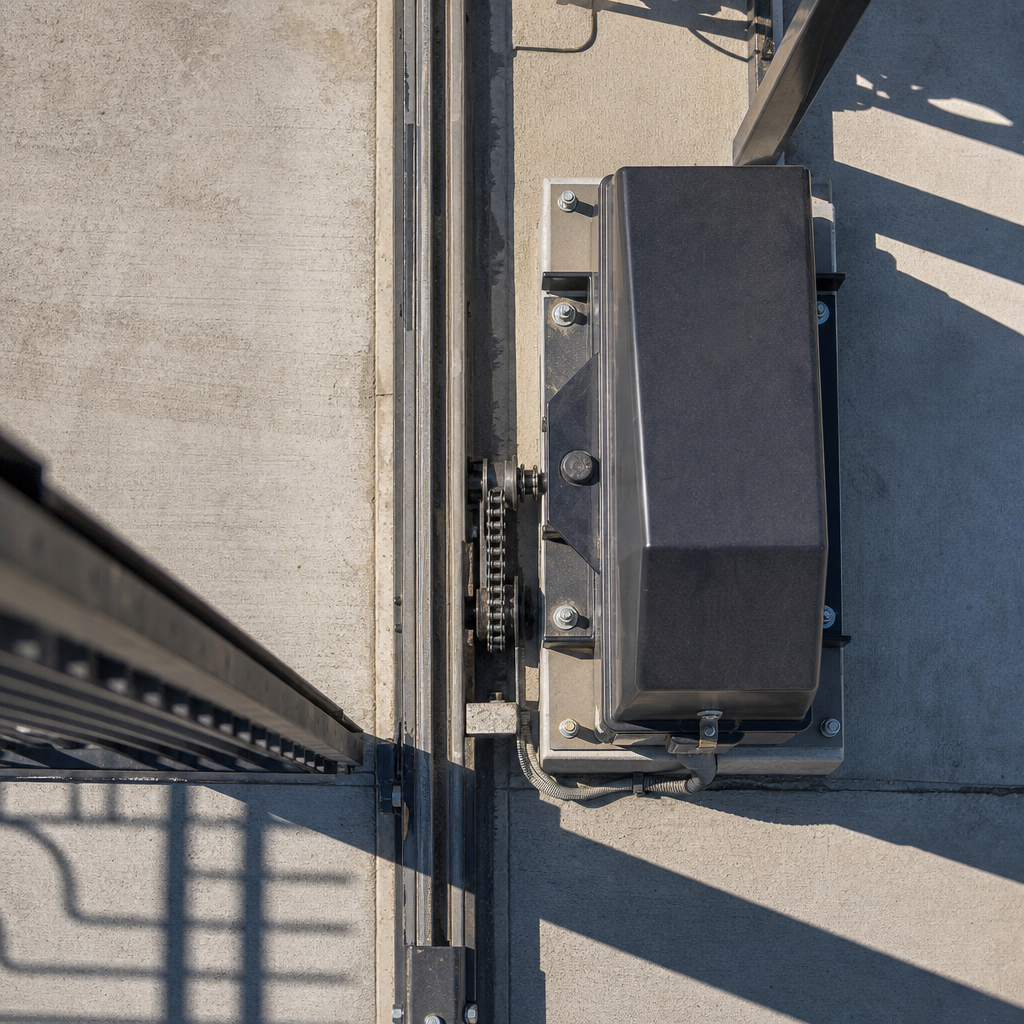
An industrial gate system is only as reliable as its weakest link. Long-term reliability depends on balancing every mechanical and electrical part.
Automatic Industrial Gate Openers
Commercial operators from manufacturers such as DoorKing (DKS), LiftMaster, FAAC, BFT, and Viking Access handle distinct cycle profiles. Hydraulic operators excel in heavy, continuous-use industrial environments due to fewer moving parts subject to friction wear. Electromechanical gear-driven units provide high reliability for standard slide gates when fitted with heavy-duty gearboxes and continuous-duty DC motors that provide battery backup functionality during power outages.[3]
Rollers, Trucks, and Hinges
For cantilever setups, heavy-gauge steel or aluminum track profiles paired with fully sealed, greased-for-life bearing assemblies prevent moisture and dirt penetration. Industrial swing gates require greaseable, heavy-duty ball-bearing hinges rated to withstand both radial weight and lateral wind loads without post deflection.
Security Gate Access Control and Commercial Gate Entry Systems
Need industrial security gates?
We’re available now — call for a fast, free estimate.
Controlling who enters an industrial facility requires integrating access hardware with the automated gate operator. Dedicated gate access control companies design multi-tiered authentication setups to keep traffic moving while maintaining strict security records.
Access Options for Commercial Operations
- Long-Range RFID & License Plate Recognition (LPR): Allows authorized company fleet vehicles and delivery trucks to enter without stopping, reducing queue lines on municipal roads.
- Heavy-Duty Commercial Keypads and Card Readers: Weather-sealed access terminals mounted on heavy gooseneck pedestals positioned for both passenger cars and semi-truck cabs.
- Cloud-Based Telephone Entry and Intercom Systems: Allows security personnel to grant access, communicate via two-way audio/video, and audit visitor logs remotely from a central operations center.
Safety Standards and UL 325 Requirements
Under the UL 325 safety standard, industrial automated gate operators fall under Class III (industrial limited-access vehicular gate operators). To comply with UL 325, automated gates incorporate monitored entrapment protection devices:[2]
- Monitored Optical Photo-Eyes: Retro-reflective or through-beam infrared sensors that project across the gate opening. If a vehicle, forklift, or pedestrian breaks the beam, the gate stops or reverses immediately.
- Monitored Contact Reversing Edges: Pressure-sensitive rubber edges running along the leading and trailing edges of the gate that trigger an instant reverse on physical contact.
- In-Ground Inductive Loops: Detection and safety loops cut into the concrete or asphalt to prevent the gate from closing on stationary trucks or trailers.
Industrial Security Gate Cost and Installation Factors
Installing an industrial security gate involves significant electrical, structural, and civil work. Turnkey project costs generally range from about $10,000 to $30,000 or more for complete systems.
Primary cost drivers include:
- Opening Width and Material: Wider openings require deeper cantilever back-frames and heavier support posts set in substantial concrete footings.
- Civil and Trenching Requirements: Running dedicated high-voltage power lines and low-voltage communication cabling through concrete or asphalt increases labor and equipment costs.
- Operator Duty Rating: Continuous-duty hydraulic and high-cycle DC operators command higher initial investments than light commercial units, but prevent expensive downtime later.
- Access Control Hardware: Video intercoms, multi-height gooseneck pedestals, and barrier arm integrations add to initial project budgets.
Working with an established commercial gate service like All Star Gate Repair Santa Clarita ensures you receive upfront, transparent pricing and properly calculated equipment specifications before installation begins.
Frequently Asked Questions About Industrial Security Gates
What are the most durable types of industrial security gates?
Cantilever slide gates built with heavy-gauge steel or structural aluminum are generally among the most durable options for industrial facilities. Because the gate is counterbalanced and does not ride on a ground track, it avoids issues associated with debris and ground track maintenance.
How much does it cost to install an industrial security gate?
Commercial security gate installation typically ranges from about $10,000 to $30,000 or more for complete systems. The total price depends on clear opening span, gate weight, the type of continuous-duty operator selected, trenching distance for power and communication wiring, and the complexity of the credential access control system.
What access control systems work best with industrial gates?
High-traffic facilities benefit most from long-range RFID readers or license plate recognition for automated fleet entry, paired with multi-height commercial telephone entry intercoms and heavy-duty card readers on gooseneck pedestals for visitor and contractor screening.
What is the difference between cantilever and roll security gates?
A cantilever gate is counterbalanced and does not ride on a ground track. A rolling gate uses a ground rail or track and requires a cleaner, flatter, better-maintained surface.
How often should commercial and industrial security gates be serviced?
High-cycle industrial gates should receive preventative maintenance every 3 to 6 months. Regular service should include checking chain tension, lubricating hinges and bearings, inspecting safety photo-eyes and loop sensors, testing operator clutch settings, and inspecting electrical wiring for signs of heat wear.[4]
What safety standards and UL 325 requirements apply to automated industrial gates?
Automated industrial vehicular gates must meet UL 325 Class III standards and ASTM F2200 construction specifications. These require structural safety guards, fall-over brackets, and monitored entrapment protection devices, such as optical photo-eyes and contact reversing edges, to protect personnel and equipment.[5]
Why is specialized industrial gate repair service important?
Industrial gate systems integrate structural welding, high-voltage power supplies, and sensitive low-voltage control boards. Experienced industrial gate repair services, such as All Star Gate Repair Santa Clarita, provide trained technicians who diagnose mechanical strain, properly balance heavy leaves, and correctly service high-duty operators like DoorKing, LiftMaster, and FAAC to prevent operational downtime.
Need industrial security gates?
We’re available now — call for a fast, free estimate.
Sources
- New Safety Standard for Automatic Security Gates Helps Prevent … – cpsc.gov (2001)
- Industrial Safety Gates Market Size & Share 2026-2032 – 360iresearch.com (2032)
- Securing Peace of Mind: Access Control and Gate Operators | UL … – ul.com (2024)
- [PDF] Industrial gates – Classification, requirements and test methods – stoldskyddsforeningen.se (2025)
- Standards for the Hidden Dangers of Gates – ASTM – astm.org
Related reading: Electric Driveway Gate Installation – 10% Off & Free Estimate – Same-Day Service
Related reading: Types of Driveway Gates | 10% Off & Free Estimate | Same-Day Service
Related reading: Electric Driveway Gate Repair | Call Now-10% Off | On-Site in 60 Minutes | Free Estimate
Frequently Asked Questions
How can high-traffic facilities prevent industrial security gate motors from overheating in extreme weather?
Facilities can avoid thermal overload shutdowns during peak shifts by installing continuous-duty hydraulic or brushless DC operators equipped with variable frequency drives (VFDs) and internal cooling systems. All Star Gate Repair Santa Clarita evaluates cycle volumes and gate leaf weights to specify properly rated drive assemblies that eliminate heat-induced motor stalls.
What happens to an automated industrial security gate during a power outage?
Commercial gate systems equipped with industrial DC motors automatically switch to battery backup units to sustain critical access cycles, or they can be configured to fail-safe or fail-secure depending on facility protocols. All Star Gate Repair Santa Clarita installs and services emergency manual releases, generator connections, and battery backups to keep logistics hubs operational during electrical grid disruptions.
Can modern access control hardware like RFID and LPR be retrofitted onto existing industrial gates?
Yes, long-range RFID readers, license plate recognition cameras, and multi-tier telephone entry intercoms can be integrated into most existing commercial gate operators using standard low-voltage relays. All Star Gate Repair Santa Clarita handles turnkey access control retrofits, ensuring all new hardware communicates seamlessly with existing gate mechanisms while maintaining full UL 325 safety compliance.
About the author
 |
Marcus Dalton Marcus Dalton is a licensed gate repair technician with over a decade of experience serving the Santa Clarita Valley. He holds an associate degree in Electrical Engineering Technology from College of the Canyons and specializes in emergency motor replacements and automated access control systems. Marcus is dedicated to providing homeowners and property managers with practical advice on maintaining secure, reliable entry systems. |
Gate not opening, off track, or opener dead?
We’re available now — call for a fast, free estimate.
Call Now - Free Estimate