
Last updated July 12, 2026
Gate Repair Maintenance Checklist for Santa Clarita Homeowners
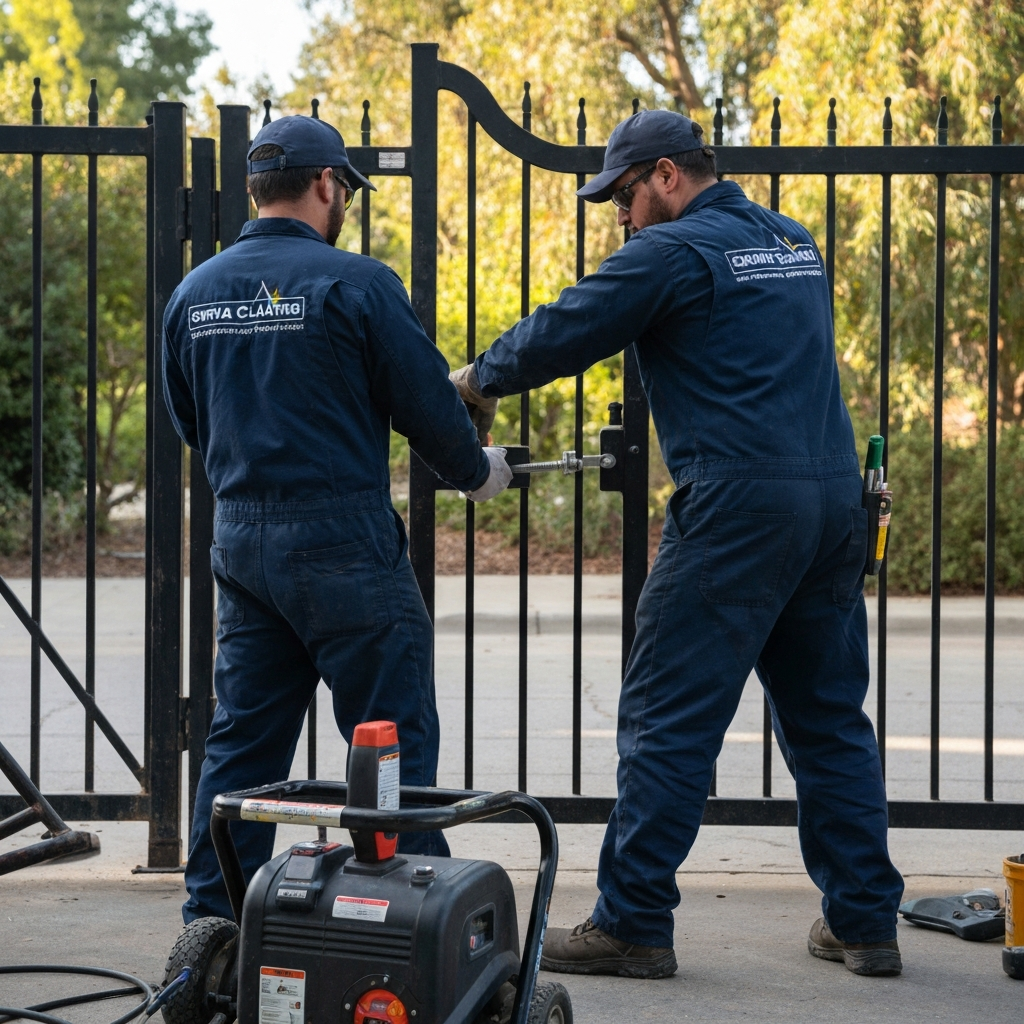
The number-one call we get after a Santa Ana wind event isn’t “my gate blew open” — it’s “my gate was already loose and the wind finished it.” Every single one of those calls was preventable with a 20-minute inspection the month before. After 15 years of gate-only work in Santa Clarita, Joseph Davis has seen the same pattern repeat itself across Valencia, Newhall, Saugus, and Canyon Country: homeowners who wait until something breaks end up paying two to three times more than homeowners who stay a step ahead. This guide gives you the exact checklist we use — season by season, hardware point by hardware point — so your gate survives everything Santa Clarita throws at it. For professional help, see our Gate Repair services.
Quick Answer
A Santa Clarita gate maintenance checklist should include four seasonal inspections per year — timed around summer heat prep, post-Santa Ana wind events, pre-rainy season alignment checks, and a mid-winter battery audit. Each inspection covers lubrication of hinges, chains, and limit switches with the correct product for each component, a limit switch reset test, and a battery backup health check. Homeowners who follow this schedule consistently can expect to cut emergency repair calls significantly and extend operator lifespan by several years.
Table of Contents
- Why Santa Clarita Gates Need a Different Maintenance Approach
- Your Quarterly Maintenance Schedule: Season-by-Season Timing
- The Right Lubricant for Every Gate Component
- How to Test and Reset Limit Switches Before They Burn Out Your Motor
- Battery Backup Health Checks: Why SCV Heat Kills Batteries Early
- How to Keep a Dated Maintenance Log (and Why It Matters)
- Common Mistakes to Avoid
- When to Call a Professional
- Frequently Asked Questions
- The Bottom Line
Why Santa Clarita Gates Need a Different Maintenance Approach
Generic gate maintenance guides are written for a generic climate. Santa Clarita isn’t generic. The Santa Clarita Valley sits in a basin that regularly sees summer temperatures above 105°F, annual Santa Ana wind events that push gusts past 60 mph through the passes above Newhall and Sand Canyon, and a short but intense rainy season that can drop two inches of rain in 24 hours on already-parched soil. Each of these conditions creates a specific failure mode in gate hardware — and a maintenance schedule that ignores them is just a list of things to do on a clipboard.
Heat above 100°F accelerates lubricant oxidation, which means the grease you applied in April may be completely dried out by July. That dried grease turns into an abrasive paste inside chain-drive housings and hinge barrels, grinding metal against metal every time the gate cycles. In our experience, gates in Santa Clarita’s hotter neighborhoods — particularly in parts of Stevenson Ranch and east-facing slopes in Saugus — show wear patterns consistent with much older hardware simply because lubrication was applied once a year instead of twice.
Santa Ana wind events put lateral stress on swing gates that their hinges were never designed to handle continuously. A hinge that’s 80% worn will hold through a hundred normal cycles and then fail in a 50-mph wind overnight. And the rainy season introduces soil expansion near post footings, which shifts gate alignment just enough that the latch or auto-close mechanism starts dragging — setting the stage for motor burnout by spring.
This is the environment your gate lives in. The checklist below is built around it.
Your Quarterly Maintenance Schedule: Season-by-Season Timing
We recommend four check-ins per year, each one targeting the failure modes that the upcoming season creates. Here’s the breakdown:
Check-In 1: Pre-Summer (Late April / Early May)
This is your most important inspection of the year. Santa Clarita summers are long and brutal, and the goal here is to make sure no component enters the heat with depleted lubrication or a marginal battery.
- Re-lubricate all hinge barrels, chain drives, and roller tracks (see lubricant guide below).
- Inspect the gate motor housing for any gaps or cracked seals that could allow heat to build internally.
- Test the battery backup under a full load cycle — replace if voltage drops below 11.5V under load.
- Check limit switch settings and run the gate through 10 full open/close cycles while watching for hesitation or grinding.
- Tighten all hinge bolts and post-mount hardware — heat causes metal expansion and contraction that works fasteners loose over winter.
- Clear debris from the gate track and sensor eyes — tumbleweeds and dust accumulate heavily in the dry spring months across Saugus and Canyon Country.
Check-In 2: Post-Santa Ana Wind Event (October–November)
Don’t wait for a scheduled date. Within 48 hours of any significant wind event, do a quick physical inspection:
- Check all hinge welds and mounting plates for cracking or separation — wind stress concentrates at weld points.
- Test the gate’s auto-close alignment. Wind loading shifts swing gates on their hinges; a gate that closed flush before the event may now drag the latch side on the ground.
- Inspect the operator arm connection for bending or loosening at both the gate-side and motor-side brackets.
- Check that the safety sensor eyes are still aligned — wind can vibrate them off-axis enough to create a false-obstruction fault.
Check-In 3: Pre-Rain Season (December)
- Re-check swing gate post footings for any visible soil shift — look for a gap or heaving at the base of steel posts.
- Apply a water-displacing lubricant to exposed hinge barrels and latch mechanisms.
- Test all drain paths around slide gate tracks — standing water in a track freezes during the rare cold snaps in the SCV’s higher elevations (Agua Dulce, Acton) and cracks track housings.
- Verify motor housing seals are intact before moisture season begins.
Check-In 4: Mid-Winter Battery Audit (January)
- Retest battery backup under load — even if you replaced it last spring, verify voltage holds.
- Check the solar panel output if your system uses one — winter sun angles reduce output, and a borderline panel will fail to keep the battery charged.
- Inspect all electrical connections at the control board for corrosion from condensation, which is more common in Santa Clarita during January marine-layer mornings than most homeowners expect.
The Right Lubricant for Every Gate Component
Using the wrong lubricant is almost as bad as using none at all. WD-40, for example, is a water displacer and a degreaser — not a long-term lubricant. We see it used on chain drives constantly, and what it actually does is strip the factory grease from the chain’s internal rollers while leaving a thin residue that dries out within weeks. Here’s what to use, and where:
- Chain drives (LiftMaster, Linear, Elite operators): Use a dedicated chain-drive lubricant — most major brands sell their own — or a white lithium grease spray. Apply along the full length of the chain while cycling the gate. Do this every six months in Santa Clarita; the heat will degrade the coating faster than the manufacturer’s annual recommendation assumes.
- Hinge barrels and pivot points: Grease-gun-compatible fittings (Zerk fittings) on quality hinges should be packed with marine-grade grease — it handles heat and resists water. For hinges without Zerk fittings, use a white lithium grease worked into the barrel with a narrow nozzle.
- Slide gate rollers: Lithium-based grease on roller axles. Avoid petroleum-based oils — they attract dust and sand, and the dust accumulation on slide gate tracks in dry SCV neighborhoods turns oiled rollers into grinding paste within a season.
- Limit switch cams and mechanical stops: Dry PTFE (Teflon) lubricant spray only. Oil-based lubricants on limit switch components attract dust that can jam the cam and cause the switch to stick in an open position — which is exactly the failure mode that leads to motor burnout.
- Latch mechanisms and strike plates: Dry graphite powder or dry PTFE spray. Do not use grease on latch components — it collects debris and eventually gums up the mechanism.
- Operator arm pivot points (FAAC, BFT, Viking operators): Check the manufacturer spec first, but most arm-style operators have sealed bearings at pivot joints that require no field lubrication. If yours aren’t sealed, a light application of white lithium at the joint is appropriate.
How to Test and Reset Limit Switches Before They Burn Out Your Motor
A limit switch tells the motor when the gate has fully opened or fully closed and it’s time to stop. When a limit switch drifts out of calibration — which happens gradually as hardware wears and mounting points shift — the motor keeps pushing after the gate has bottomed out. It’s fighting against the physical stop, and that electrical load eventually burns the control board. A replacement board for a LiftMaster or FAAC operator runs $350–$500 installed. A limit switch adjustment takes about five minutes and costs nothing.
Here’s how to test yours:
- Cycle your gate through a full open and close while watching the operator. At the fully open and fully closed positions, the motor should stop within one to two seconds of the gate reaching the end of travel. If the motor continues to hum or strain after the gate stops moving, the limit switch is not cutting out at the right point.
- On most residential operators — including common LiftMaster and Linear models — limit switches are adjusted via two small rotary dials or screws on the control board, labeled “OPEN” and “CLOSE.” Turn the relevant dial in small increments (one-quarter turn at a time) and retest after each adjustment.
- On arm-style operators like FAAC and BFT units, limit switches are often mechanical cams mounted on the drive shaft inside the housing. These require the housing to be opened and the cam position adjusted. If you’re not comfortable opening the motor housing, this is the right task to hand off to a professional.
- After adjustment, run ten full cycles and confirm the motor stops cleanly at both endpoints with no continued strain.
- Document the setting in your maintenance log (see section below) so you have a baseline if the gate shifts again next season.
In our 15 years of gate work across Santa Clarita, limit switch drift is one of the top five causes of premature motor failure — and it’s almost always caught too late. The symptom is subtle: a faint hum or a half-second of motor noise after the gate stops. Most homeowners don’t notice until the control board is already fried.
Battery Backup Health Checks: Why SCV Heat Kills Batteries Early
Battery backup systems on gate operators are rated for a certain number of cycles and a certain lifespan under standard temperature conditions — typically around 77°F. Santa Clarita does not operate at 77°F for most of the year. A battery backup unit stored in a black metal operator housing on a south-facing wall in Valencia or Stevenson Ranch can reach internal temperatures of 130°F or higher during peak summer. At those temperatures, lead-acid and AGM batteries lose capacity at a rate roughly double what the manufacturer’s lifespan rating assumes.
What this means practically: a battery rated for three to four years may be functionally depleted in 18 to 24 months in a Santa Clarita installation. We’ve replaced batteries on relatively new Ghost Controls and DoorKing systems because a homeowner lost gate access during a power outage and assumed the backup was operational — it wasn’t, because the battery had cooked through two consecutive summers.
How to check your battery backup:
- Use a multimeter to check resting voltage. A healthy 12V gate backup battery should read 12.6–12.8V at rest. Below 12.0V at rest indicates a degraded battery.
- More importantly, check voltage under load. Connect your multimeter while the gate cycles. If voltage drops below 11.5V under load, the battery doesn’t have enough capacity to reliably open your gate during an outage — replace it regardless of its age on paper.
- Check the charging circuit at the same time. A battery that keeps failing may be doing so because the operator’s charging circuit is underperforming. If a new battery shows the same low-voltage symptoms within a few months, have the charger circuit tested.
- For operators with solar charging (common in rural SCV lots in Agua Dulce and Sand Canyon), check panel output with a multimeter at the controller input terminals on a clear day. Panels coated in dust and grime from dry SCV summers can lose 30–40% of their rated output.
How to Keep a Dated Maintenance Log (and Why It Matters)
A maintenance log isn’t paperwork for paperwork’s sake. In Santa Clarita, where HOA-governed communities are common across Valencia, Stevenson Ranch, and Copper Hill, a documented service history has real practical value when an HOA disputes responsibility for a gate repair, when a manufacturer warranty claim requires proof of maintenance, or when you’re selling your home and a buyer’s inspector flags the gate system.
Keep the log simple and dated. Here’s the format we recommend:
- Date of inspection
- Gate type and operator brand/model (e.g., “LiftMaster LA500, dual swing”)
- Tasks performed (lubrication points hit, limit switch checked/adjusted, battery voltage reading)
- Battery voltage reading under load
- Limit switch setting at open and close (note the dial position or cam position)
- Any wear observed (hinge slop, roller wear, weld cracks) and action taken
- Parts replaced with brand, part number, and supplier
- Who performed the work (homeowner self-service or professional technician, with contact info)
A photograph attached to each log entry — especially of hinge welds and hardware condition — adds significant documentation value. You can keep this in a folder on your phone, a notes app, or a physical binder in the garage. The format matters less than the consistency.
When Joseph Davis responds to a service call where the homeowner has a log like this, diagnosis time drops significantly. We can see exactly when the last lubrication happened, what the battery was reading three months ago, and whether the current problem is a new failure or a chronic drift. That saves time and saves the homeowner money.
Common Mistakes to Avoid
- Lubricating once a year and assuming it holds. In most U.S. climates, annual lubrication is adequate. In Santa Clarita’s summer heat, lubricants degrade significantly faster — a once-a-year schedule means your gate runs dry for four to six months before each service. Plan for at least two lubrication cycles per year.
- Using WD-40 on chain drives. WD-40 strips the factory lubricant from chain internals and leaves a film that dries out in weeks. We regularly see chains with accelerated wear on operators that were “well maintained” with WD-40 for years. Use a dedicated chain lubricant or white lithium grease.
- Ignoring a half-second motor hum after the gate stops. That sound is the motor fighting against a physical stop because the limit switch isn’t cutting out in time. Left unaddressed, it burns the control board. One adjustment takes five minutes; a new board costs several hundred dollars installed.
- Trusting the manufacturer battery lifespan rating in SCV conditions. Those ratings are tested at controlled temperatures that Santa Clarita doesn’t maintain. In this climate, plan to test battery backup annually and expect replacement every 18–24 months for operators in direct sun exposure.
- Skipping the post-wind-event inspection. Santa Ana events in the SCV often damage gate hardware in ways that aren’t visually obvious until the next failure. A hinge that took 50-mph lateral loading may look fine but be cracked at the weld root — a failure waiting for the next windy night. Check after every major wind event, not just on your quarterly schedule.
- Applying grease to latch and limit switch mechanisms. Grease on these components collects dust and fine debris, eventually jamming the very parts you were trying to protect. Dry PTFE spray or graphite is the correct choice for these points.
- Assuming a new operator doesn’t need maintenance. In Stevenson Ranch and Valencia, we frequently service BFT and FAAC operators that were installed by a big-box contractor, handed off to the homeowner with no maintenance guidance, and failed within two years because the chain was never lubricated after installation. “New” doesn’t mean “maintenance-free.”
When to Call a Professional
Some gate maintenance tasks are genuinely homeowner-friendly. Others are either dangerous or likely to create larger problems if handled without the right tools and experience. Call a professional when:
- You notice a visible crack in a hinge weld, post weld, or operator mounting bracket — structural weld repairs require proper equipment and metallurgical knowledge, not a hardware-store fix.
- Your operator control board is showing fault codes you can’t clear, or the gate is cycling erratically despite a clean limit switch adjustment.
- A hinge is bent or a gate post has shifted at its footing — realignment requires measuring tools and, often, re-welding or concrete work.
- The gate motor runs but the gate doesn’t move — this usually indicates a broken drive gear, shear pin, or clutch failure inside the operator housing that requires teardown to diagnose.
- You have a commercial-grade operator — FAAC, BFT, Viking, or DoorKing commercial units — where internal component access involves higher-voltage circuits.
Gate Repair in Santa Clarita from All Star Gate Repair means Joseph Davis handles the diagnosis personally — not a subcontractor. We offer free estimates in Santa Clarita, so there’s no cost to getting a professional opinion. Call us at (855) 772-6931.
Frequently Asked Questions
How often should I lubricate my gate in Santa Clarita?
In Santa Clarita, you should lubricate your gate’s chain drive, hinges, and roller components at least twice a year — once in late April before summer heat arrives and once in December before the rainy season. The SCV’s temperatures regularly exceed 100°F, which degrades lubricants faster than the manufacturer’s annual recommendation accounts for. Limit switch cams and latch mechanisms should be treated with dry PTFE lubricant on the same schedule.
What’s the best lubricant for a gate chain drive?
The best lubricant for a gate chain drive is a dedicated chain-drive lubricant (available from LiftMaster, Linear, and other major brands) or a white lithium grease spray. Avoid WD-40 — it’s a degreaser that strips chain internals and leaves a residue that dries out within weeks. In hot climates like Santa Clarita’s, white lithium grease holds up better through summer than lighter spray oils.
How do I know if my gate’s limit switches need adjustment?
Your limit switches need adjustment if the motor continues to hum or strain for more than one to two seconds after the gate reaches its fully open or fully closed position. That continued motor load is the gate fighting against a physical stop, and it’s the primary cause of control board burnout in residential operators. Run your gate through a full cycle and listen carefully at both endpoints — a clean stop means the limit switches are calibrated correctly.
How long do gate backup batteries last in Santa Clarita?
Gate backup batteries typically last 18 to 24 months in Santa Clarita, compared to the three-to-four-year lifespan rated by most manufacturers. The difference is heat: operator housings in direct sun on south-facing walls in the SCV can reach internal temperatures of 130°F or higher during summer, which degrades battery capacity at roughly double the rated rate. Test your battery voltage under load annually and replace proactively — don’t wait to find out it’s dead during a power outage.
Do HOAs in Santa Clarita require gate maintenance documentation?
Many HOAs in Santa Clarita — particularly in Valencia, Stevenson Ranch, and Copper Hill — include gate maintenance and appearance standards in their CC&Rs, and some specifically require documentation of service history before approving repair or replacement claims. Even where documentation isn’t explicitly required, a dated maintenance log protects homeowners in any dispute about whether neglect contributed to a failure. We recommend keeping a log regardless of HOA requirements, as it also supports manufacturer warranty claims.
What gate brands does All Star Gate Repair service in Santa Clarita?
All Star Gate Repair services all major residential and commercial gate brands in Santa Clarita, including LiftMaster, FAAC, BFT, Linear, Viking, Ghost Controls, DoorKing, Elite, and Ramset. If you need help choosing, read How to Hire a Gate Repair Contractor in Santa Clarita: A Step-by-Step Guide. Joseph Davis has 15 years of hands-on experience with each of these systems, so whatever operator you have — whether it was installed last year or a decade ago — we know it and carry or source the parts for it. You won’t be told a repair isn’t possible because of the brand you own.
The Bottom Line
Santa Clarita’s heat, seasonal wind events, and dry-to-wet climate swings create gate failure conditions that generic maintenance advice simply doesn’t address. A four-check-per-year schedule — timed around pre-summer heat prep, post-Santa Ana wind events, pre-rain alignment, and a mid-winter battery audit — directly targets the failure modes this climate produces. Use the right lubricant for each component, test your limit switches before they cause a board burnout, stay ahead of battery degradation, and keep a dated log. These aren’t complicated tasks. But they’re the difference between a gate that serves you reliably for 15 years and one that leaves you stranded at the driveway after the first October wind event.
If any of these inspections surfaces a problem you’re not comfortable handling, or if your gate is already showing signs of wear, we’re here. Explore our full All Star Gate Repair Santa Clarita home page for everything we offer, or learn more about Gate Motor & Opener in Santa Clarita if your operator is the concern. And if you’re thinking about upgrading your system entirely, our Gate Installation in Santa Clarita page walks you through what that process looks like with us. Joseph Davis has led every job we’ve done for 15 years — nearly 700 five-star reviews later, that commitment hasn’t changed. Call (855) 772-6931 for a free estimate, and let’s make sure your gate is ready for whatever season is coming next.
Written by the team at All Star Gate Repair Santa Clarita, serving Santa Clarita since 2011.