
Last updated July 12, 2026
The Complete Guide to Gate Repair in Santa Clarita
Most gate failures don’t happen suddenly — they build quietly over months of UV exposure, wind stress, and thermal cycling until the day the gate won’t open and you’re late for work. After 15 years of service calls across Santa Clarita, Joseph Davis has seen this pattern hundreds of times. What makes SCV different from the Los Angeles Basin is the specific combination of forces working against your gate: Santa Ana wind events pushing through the pass corridor, summer temperatures that regularly hit triple digits in Canyon Country, and sloped hillside lots in Stevenson Ranch that put mechanical stress on gates that a flat-lot installation simply never faces. This guide — along with our Gate Repair Maintenance Checklist for Santa Clarita Homeowners — maps every major repair category to the local conditions that cause it, so you can spot problems early, know what’s worth a DIY fix, and understand exactly when you need a specialist.
Quick Answer
Gate repair in Santa Clarita typically involves diagnosing one of five failure points: structural damage to posts or rails, hinge and roller wear, motor or operator failure, access control malfunction, or misalignment caused by ground movement or wind stress. Because Santa Clarita’s climate — high UV, Santa Ana winds, and significant summer heat — accelerates wear faster than most Southern California markets, proactive inspection every six to twelve months is the most effective way to avoid a full replacement. A qualified gate specialist can usually restore a failing gate to full function in a single visit when the problem is caught before it compounds.
Table of Contents
- How Santa Clarita’s Climate Destroys Gates Faster Than You’d Expect
- Santa Ana Winds, Hinge Wear, and Swing Gate Alignment
- Hillside and Sloped Driveways: Why Canyon Country and Stevenson Ranch Gates Fail Differently
- The Full Gate Repair Spectrum: From Post Re-Setting to Operator Board Replacement
- Gate Materials and UV Degradation in Santa Clarita
- HOA Rules in SCV Master-Planned Communities and What They Mean for Repairs
- What’s a DIY Task vs. What Requires a Specialist
- Common Mistakes to Avoid
- When to Call a Professional
- Frequently Asked Questions
- The Bottom Line
How Santa Clarita’s Climate Destroys Gates Faster Than You’d Expect
Santa Clarita sits at the intersection of three distinct microclimates — the high desert heat pushing down from the Antelope Valley, marine influence occasionally moderating the western end of the valley, and the Santa Ana wind corridor running through the passes. That combination is punishing for gate hardware in ways that most general-purpose gate guides never acknowledge.
The UV index in Santa Clarita regularly exceeds 10 during summer months, which is on par with desert cities like Palm Springs. That level of sun exposure doesn’t just fade paint — it embrittles rubber seals in motor housings, degrades vinyl gate panels from the inside out, and causes metal fasteners to expand and contract in cycles that gradually strip threads and loosen connections. A LiftMaster or FAAC motor installed on an exposed south-facing post in Valencia will age noticeably faster than the same unit installed in a more sheltered coastal location.
Summer temperatures in parts of Canyon Country can exceed 105°F during peak heat events. At those temperatures, lubricants burn off rollers and hinges faster than the manufacturer’s recommended service interval assumes. We regularly see customers whose chain or belt drives have become so dry and stiff by August that they’re forcing the motor to work at 150% of its designed load — burning out circuit boards months before their time.
- UV index above 10: accelerates rubber and vinyl degradation on motor seals and panel surfaces
- Triple-digit summer heat: depletes lubricants on rollers, hinges, and drive systems faster than the standard 12-month service interval accounts for
- Thermal cycling: metal posts and rails expand in daytime heat and contract overnight, gradually shifting gate alignment over one to three seasons
- Low humidity periods: dried-out wooden gate components can split, warp, and pull away from hardware mounts during extended dry spells
The practical implication is that Santa Clarita homeowners should budget for gate service on a six-to-nine-month cycle rather than the standard annual recommendation, particularly if the gate faces south or west and has no overhead shade.
Santa Ana Winds, Hinge Wear, and Swing Gate Alignment
Santa Clarita’s position in the pass corridor makes it one of the highest-exposure Santa Ana wind zones in the greater Los Angeles area. Wind events here regularly reach 40–60 mph, with gusts exceeding 80 mph during major events. For swing gates specifically, those wind loads are catastrophic over time in ways that aren’t always obvious until alignment has drifted past the point of self-correction.
Here’s the mechanics of what happens: a swing gate hangs from two or three hinges anchored to a post. Under normal conditions, the gate’s weight is distributed evenly and the hinges carry a static load. When a 60 mph gust hits a solid or semi-solid gate panel, it creates a lateral force that the hinges were never designed to absorb repeatedly. Each wind event slightly deforms the hinge mounting, loosening the anchor bolts or bending the hinge leaves by fractions of a millimeter. Over three or four Santa Ana seasons, that cumulative deformation produces a gate that sags, drags on the ground, or fails to latch.
In our 15 years of service calls across Santa Clarita, hinge-related alignment problems spike sharply in November through February — right after the peak wind season. The repair isn’t always dramatic: sometimes it’s re-torquing anchor bolts and shimming the hinge plate. Other times, the hinge itself has fatigued and needs to be cut off and replaced with a heavier-gauge unit. On posts that have been pulled forward by repeated wind load, we re-set the post in fresh concrete — a repair that requires the right equipment and isn’t a candidate for a DIY fix.
If your swing gate has started dragging on the ground or won’t latch cleanly after a significant wind event, don’t force it. Forcing a misaligned gate strains the motor arm and can crack the operator mounting bracket — turning a $200 alignment repair into a $600 bracket-and-motor job.
Hillside and Sloped Driveways: Why Canyon Country and Stevenson Ranch Gates Fail Differently
Flat-lot gate installations in Valencia or Newhall operate under relatively predictable mechanical conditions. Hillside installations in Canyon Country, Stevenson Ranch, and parts of Sand Canyon introduce variables that require a different engineering approach — and create different failure patterns when something goes wrong.
The fundamental challenge with a sloped driveway is that gravity is always working against the gate. A slide gate on a flat lot rolls on a level track; a slide gate on a slope is constantly fighting to drift downhill. The motor has to work harder to push the gate uphill on opening and has to actively hold the gate from accelerating on the closing stroke. Over time, this asymmetric load wears the drive gear and track hardware significantly faster than comparable flat-lot units.
Swing gates on sloped lots present their own set of problems. Proper installation on a slope requires either a raked gate (the bottom rail follows the grade) or a stepped gate design with adequate clearance — and when the wrong design is installed, or when ground settlement shifts the grade slightly, the gate starts dragging or binding mid-arc. We’ve seen this pattern consistently in newer construction areas of Canyon Country where soils are still settling in the first three to five years after grading.
Specific failure patterns we see on sloped SCV installations:
- Slide gates: accelerated rack gear wear on the uphill side, track debris accumulation in the low point of the slope, and chain stretch due to constant uphill load
- Swing gates: ground-dragging on the arc due to grade shift, arm connector stress fractures from the motor working against gravity on steep driveways
- Post movement: hillside soils with clay content (common in Canyon Country) can shift seasonally with rain saturation, slowly tilting posts out of plumb even without a seismic event
- Underground drainage: sloped lots channel rainwater toward low points — which are often exactly where post footings are poured, accelerating corrosion at the base
If your property has a grade change of more than 2–3%, the gate system needs to be designed and serviced with that slope in mind. A technician who approaches it the same way they’d approach a flat Valencia lot is going to miss the root cause of the problem.
The Full Gate Repair Spectrum: From Post Re-Setting to Operator Board Replacement
Gate repair is not a single service — it’s a spectrum that runs from minor mechanical adjustments you can handle yourself to structural and electrical repairs that require specialized tools, parts, and experience. Here’s an honest breakdown of where different repairs fall on that spectrum.
Level 1: Maintenance-Grade Repairs (DIY-Appropriate)
- Lubrication: Apply a lithium-based grease to hinges, rollers, and chain or rack every four to six months in Santa Clarita’s climate. Don’t use WD-40 — it’s a solvent, not a lubricant, and it will dry out faster in the heat.
- Limit switch adjustment: Most LiftMaster, Viking, and Linear operators have user-adjustable open and close limit switches. If the gate isn’t opening fully or is reversing before it closes, a limit adjustment (covered in the operator manual) is often the fix.
- Safety sensor alignment: Photo-eye sensors that have drifted out of alignment are a common cause of gates that won’t close. Realigning them is typically a two-minute task.
- Battery backup replacement: Sealed lead-acid batteries in gate operators typically last two to three years. Replacing them is straightforward and should be done proactively rather than waiting for a power-outage failure.
Level 2: Mechanical Repairs (Borderline — depends on your skills)
- Hinge tightening and minor adjustment: Re-torquing loose hinge bolts is manageable. Replacing bent or fatigued hinges requires welding equipment and structural judgment that most homeowners don’t have.
- Roller replacement on slide gates: Replacing worn track rollers is a physical task, but requires lifting the gate, which can be dangerous without the right equipment.
- Keypad and intercom replacement: Swapping a DoorKing or Linear access control keypad is usually plug-and-play if the wiring is intact — but diagnosing why the old one failed requires electrical knowledge.
Level 3: Specialist Repairs (Call a Pro)
- Post re-setting in concrete — requires breaking out the old footing and resetting in the correct alignment
- Operator circuit board replacement — boards for BFT, FAAC, and Elite systems require programming knowledge and are easy to damage with incorrect installation
- Structural welding on rails, frames, or post mounts — improper welds fail under load
- Crash or vehicle-impact repair — the damage is rarely limited to what’s visible
- Underground wiring faults — finding and splicing a buried wire fault requires a line tracer and proper weatherproof connectors
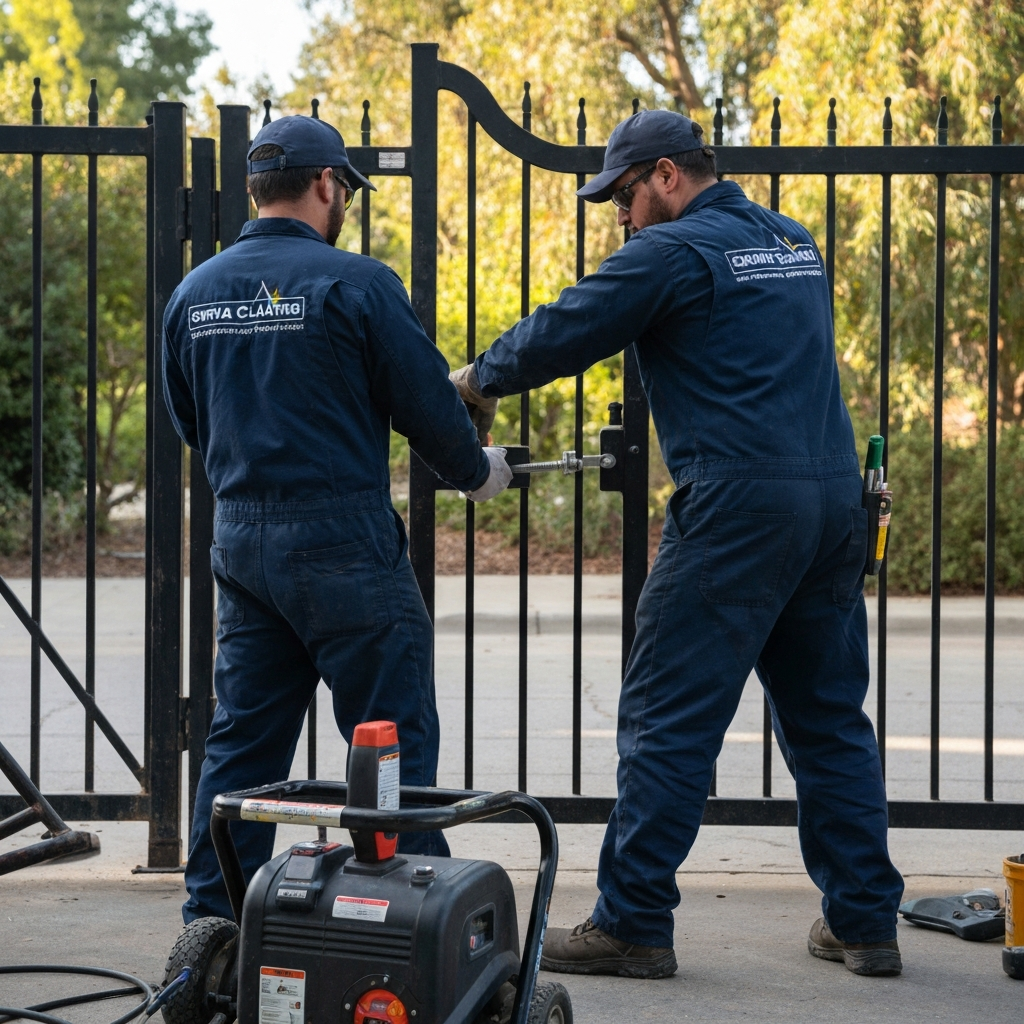
Our Gate Repair in Santa Clarita service covers the full Level 3 spectrum, and Joseph handles the structural and electrical work personally — not delegated to a less experienced crew member.
Gate Materials and UV Degradation in Santa Clarita
The material your gate is made from determines both its failure timeline and the repair options available when problems emerge. In Santa Clarita’s high-UV, high-heat environment, material choice matters more than it would in a milder climate.
Wrought Iron and Steel
The most structurally durable option, but not immune to Santa Clarita conditions. The real threat is rust — and it starts at the joints, weld points, and any area where the powder coat or paint has been chipped. In Canyon Country’s dry heat, surface rust can advance quickly during the wet winter months if protective coating isn’t maintained. We recommend a fresh coat of rust-inhibiting paint or powder coat touch-up every three to five years. Structurally, wrought iron gates can be repaired by welding indefinitely — a major advantage over other materials.
Aluminum
Aluminum doesn’t rust, which makes it popular in Santa Clarita’s HOA communities like West Creek and Tesoro where paint maintenance compliance is enforced. It does oxidize, producing a chalky white surface film, and it’s softer than steel — meaning vehicle impacts and even heavy wind stress can bend aluminum frames in ways that require section replacement rather than straightening. Lighter weight also makes aluminum swing gates more susceptible to wind loading.
Wood
Wood gates in Santa Clarita face a relentless challenge: the climate alternates between intense dry heat and occasional heavy rainfall, which causes repeated expansion and contraction. Cedar and redwood hold up better than pine, but even quality wood gates typically need re-sealing every two years and hardware inspection every season. Warping is the most common failure mode, and a warped wood gate usually can’t be straightened — the panel needs to be rebuilt.
Vinyl and Composite
Vinyl is marketed as low-maintenance, but Santa Clarita’s UV intensity is harder on vinyl than manufacturers typically disclose. UV degradation causes vinyl to become brittle and lose color within seven to ten years in full sun exposure. Cracked vinyl panels can’t be welded — they’re replaced section by section. If you have a vinyl gate on a south or west-facing installation with no shade, budget for panel replacement on a ten-year cycle.
HOA Rules in SCV Master-Planned Communities and What They Mean for Repairs
Santa Clarita has a high concentration of master-planned HOA communities — Tesoro, West Creek, Westridge, Copper Hill, and Aliento, among others. If you live in one of these communities, gate repairs are not purely a mechanical decision. They’re an architectural one, too.
Most SCV HOAs require an Architectural Review Committee (ARC) approval for any modification that changes the gate’s appearance, materials, or dimensions. The critical distinction is between a like-for-like repair and a modification. Replacing a broken hinge with an identical hinge is a repair. Replacing a wrought iron gate panel with an aluminum one — even if it looks similar — is likely a modification requiring approval.
Where homeowners get into trouble:
- Replacing a damaged gate with a different style or material without ARC approval, then receiving a correction notice months later
- Installing a gate motor or keypad entry system on a gate that didn’t previously have one — often requires approval as a new installation
- Changing gate color during repainting without confirming the approved palette — some HOAs in Stevenson Ranch have a very specific approved color list
- Adding security cameras to gate posts, which some HOAs treat as a structural modification
Our advice: before any repair that changes your gate’s appearance, pull out your HOA’s CC&Rs and check the ARC submission process. In our experience, approval turnarounds in SCV HOA communities range from two to six weeks. If you need an emergency repair after a crash or wind event, document the pre-existing condition with photos immediately — most HOAs have provisions for emergency repairs with after-the-fact approval when the original condition is clearly documented.
What’s a DIY Task vs. What Requires a Specialist
Being honest about this distinction saves homeowners money in both directions — it identifies what you genuinely don’t need to pay a technician for, and it prevents the more expensive mistake of a DIY attempt that damages a repairable system.
Reasonable DIY Tasks
- Lubricating hinges, rollers, and chain or rack with appropriate grease
- Replacing the remote control battery or reprogramming a lost remote to an existing system
- Cleaning photo-eye sensor lenses and realigning them
- Replacing a dead battery backup in a Ghost Controls, Viking, or LiftMaster operator
- Clearing debris from the gate track on a slide gate
- Adjusting open/close travel limits on operators that have accessible limit switch controls
Tasks That Require a Specialist
- Any repair involving the gate operator’s circuit board — incorrect installation voids the unit and can cause erratic behavior
- Post re-setting or footing repair — requires concrete work and structural alignment tools
- Structural welding on rails, frames, or motor mounts
- Underground wiring fault location and repair
- Programming commercial access control systems (DoorKing, BFT, FAAC) — configuration errors can lock out an entire property
- Any repair following a vehicle impact — the damage extends beyond what’s visually obvious
- Replacing a failed Ramset anchor or post base in a concrete-set installation
If you’re not certain which category your problem falls into, a quick diagnostic call is faster and cheaper than a failed DIY attempt. Joseph can often narrow down the likely cause over the phone before scheduling a visit — which is one of the advantages of talking to someone who’s seen nearly every gate failure pattern Santa Clarita produces.
Common Mistakes to Avoid
- Using WD-40 as a gate lubricant. WD-40 is a water displacer and light solvent — it will loosen existing grease, leave the metal temporarily slick, and then evaporate, leaving the hinge or roller drier than before. Use a lithium-based grease or a dedicated gate lubricant instead.
- Forcing a gate that’s binding or dragging. Forcing a gate that isn’t moving freely sends the motor into overcurrent protection and can burn out the operator board. Stop the gate, identify the obstruction or misalignment, and address the root cause before running the operator again.
- Ignoring small alignment changes after a wind event. In Santa Clarita’s pass corridor, a gate that’s “just slightly” off after a Santa Ana event will be significantly misaligned after the next one. Small alignment problems compound — catch them early while it’s a bolt-tightening job rather than a post re-set.
- Hiring a general handyman for operator or board-level repairs. Gate operator circuit boards for FAAC, BFT, Elite, and similar brands require brand-specific programming and diagnostics. A general handyman who replaces the wrong board or misconnects a wire can destroy a $400 operator. Gate-specific experience isn’t optional for this category of repair.
- Skipping the HOA approval step on visible repairs. In communities like Tesoro and West Creek, making an unapproved change to your gate — even a well-intentioned upgrade — can result in a mandatory reversal at your own cost. A five-minute review of your ARC guidelines before ordering materials is always worth it.
- Overlooking post-base corrosion on hillside lots. In Canyon Country and Stevenson Ranch, sloped lots channel water toward post footings. The concrete itself may look fine while the embedded steel post base is corroding from the inside. By the time the post starts leaning visibly, the base repair is significantly more involved than it would have been caught a year earlier.
- Assuming a gate that “works” doesn’t need service. A gate that opens and closes is not necessarily a gate that’s operating within safe parameters. Limit switches set too tight, a motor running over its rated current, or a battery backup at 20% capacity are all failure conditions that won’t show up until the day they matter most. A six-month inspection catches these before they cascade.
When to Call a Professional
Call a gate specialist — not a general handyman — when you’re dealing with any of the following situations: your gate has been struck by a vehicle; a post has visibly shifted or is no longer plumb; the motor is running but the gate isn’t moving; the operator’s LED is showing an error code you can’t clear with a reset; the gate reverses unexpectedly during opening or closing with no obstruction present; or you’re hearing grinding, popping, or metal-on-metal sounds that weren’t there last month.
Any of these conditions indicates a problem that’s either already causing secondary damage or is about to. In Santa Clarita’s climate, a marginal mechanical problem that’s ignored through a summer heat season or a Santa Ana wind event will be a significantly larger repair by the time it fails completely.
All Star Gate Repair Santa Clarita offers free estimates across Santa Clarita — call (855) 772-6931 to describe what you’re seeing and Joseph will give you a straight answer on what it’s likely to take to fix it.
Frequently Asked Questions
How much does gate repair cost in Santa Clarita?
Gate repair in Santa Clarita typically ranges from $150 to $900 for most residential jobs, with the cost driven by the type of repair rather than the brand. A hinge replacement or alignment adjustment on a swing gate generally runs $150–$350. Operator board replacement for a LiftMaster, FAAC, or BFT unit typically falls in the $300–$600 range including parts. Post re-setting is a structural job that usually runs $500–$900 depending on footing depth and access. Vehicle-impact damage is the widest range — $400 to over $1,500 depending on how much of the structure needs replacement. Getting a specific estimate before approving work is always the right move.
Why does my gate keep reversing before it closes?
A gate that reverses before closing is almost always responding to one of three triggers: a dirty or misaligned photo-eye sensor that thinks it’s detecting an obstruction, a close limit switch set too tight, or an obstruction in the gate’s travel path that you haven’t noticed yet. Start by cleaning the photo-eye lenses and checking that both sensors are aimed directly at each other. If that doesn’t resolve it, the limit switch adjustment is the next step — and if it’s still reversing after that, the issue may be a failing motor or a mechanical bind that the operator’s auto-reverse safety is correctly responding to.
Do Santa Ana winds actually damage gates?
Yes — and in Santa Clarita specifically, Santa Ana wind damage is one of the most common causes of swing gate misalignment and hinge failure we see. Wind events in the SCV pass corridor regularly exceed 50 mph, and solid or semi-solid gate panels act as sails, putting enormous lateral stress on hinge mounts and post anchors with every event. The damage is cumulative — each wind season adds a small amount of deformation until the gate starts dragging, sagging, or failing to latch. Gates that face west or are on exposed hillside lots in Stevenson Ranch or Canyon Country are most vulnerable.
Can I repair my HOA gate without approval in Tesoro or West Creek?
Like-for-like repairs — replacing a broken hinge with an identical hinge, for example — generally don’t require ARC approval in most SCV HOA communities. Any change that alters the gate’s appearance, material, dimensions, or adds new features (such as a motor where none existed before) typically does require ARC approval. Check your community’s CC&Rs before ordering materials, and if you’ve had emergency damage from a wind event or vehicle impact, document the original condition with photos immediately to support an after-the-fact approval request. HOA approval timelines in Santa Clarita communities typically run two to six weeks for standard requests.
How long do gate motors last in Santa Clarita’s climate?
A well-maintained gate motor in Santa Clarita should last eight to twelve years under normal residential use. However, the combination of high UV exposure, triple-digit summer heat, and Santa Ana wind stress accelerates wear on circuit boards, motor windings, and external wiring harnesses compared to milder climates. LiftMaster and Viking units tend to be more heat-tolerant due to their thermal protection features. FAAC and BFT commercial-grade operators often outlast the eight-to-twelve-year range when serviced correctly. The single biggest variable is whether the battery backup is replaced proactively — a dead battery backup forces the motor to carry the full load on every power fluctuation, which shortens its lifespan measurably.
What’s the difference between gate repair and gate installation — when does repair stop making sense?
Repair stops making financial sense when the cost of restoring the existing gate exceeds roughly 60–70% of the cost of a new installation, or when the structural frame itself — posts, rails, or concrete footings — has failed to the point where any repair is built on a compromised foundation. In practice, a gate with a failed motor but a solid frame and undamaged panels is almost always worth repairing. A gate with a corroded post base, a bent rail, and a failing operator on a hillside lot in Canyon Country is often a better candidate for full replacement. Joseph will give you an honest assessment of which side of that line your gate falls on — and if a new installation makes more sense, our Gate Installation in Santa Clarita service covers full design and build. For motor-specific issues alone, the Gate Motor & Opener in Santa Clarita service addresses replacements and upgrades without a full rebuild.
The Bottom Line
Gate repair in Santa Clarita is more climate-specific than most guides acknowledge. The Santa Ana winds, UV intensity, triple-digit summer temperatures, and hillside lot grades across Canyon Country, Stevenson Ranch, and the broader SCV valley create failure patterns that don’t show up on a generic gate repair checklist. Catching alignment drift after wind season, lubricating on a shortened six-to-nine-month cycle, respecting your HOA’s ARC process before making visible changes, and knowing which repairs genuinely require a specialist versus which ones you can handle yourself — these are the habits, along with the more guides & resources we publish, that keep a gate running reliably for fifteen or twenty years instead of eight. When something does go wrong, the difference between a $200 adjustment and a $900 structural repair is usually how quickly you address it.
If your gate is showing any of the warning signs covered in this guide, call (855) 772-6931 for a free estimate. Joseph Davis will give you a straight diagnosis and an honest recommendation — no upselling, no runaround, no rotating crew of unfamiliar faces.
Written by the team at All Star Gate Repair Santa Clarita, serving Santa Clarita since 2011.